

Blog
Receiving the ball in field hockey – forehand, reverse, on the run and under pressure: technique and drills

This is a follow-up to the post Push, flick, slap and hit – the basic plays and what in a stick makes them easier. That text describes how to send the ball; this one describes how to receive it. Receiving the ball in field hockey is the first touch on the ball after a pass: the stick stops it or immediately directs it to where the next play can be made. Below: stance and grip, receiving on the forehand and on the reverse, receiving on the run, under pressure from an opponent and from the air, the rules that apply to receiving, mistakes, and six drills for pairs and small groups.
We describe the technique for an outfield player on grass. Indoors the ball behaves differently and different rules apply; that is covered in a separate post on the differences in indoor hockey rules. Do drills with harder passes and with a raised ball in shin guards and a mouthguard, under a coach’s supervision.
Receiving the ball in field hockey: what a good reception means
A good reception is not just a ball that did not bounce away. It is a ball that, after the first touch, lies where you can make your next move straight away: pass, run with it or hit. Coaching distinguishes two kinds of reception:
- The stopping reception. The stick takes the pace off the ball and keeps it close. It is useful when you have time and space or when you need to calm the play down.
- The directional reception. The stick does not stop the ball but changes its direction, for example forwards, into open space or away from an opponent. The first touch then becomes the first step of the move.
At the start of learning players practise the stopping reception, because it teaches control. In a match the directional reception gives the advantage: a player who receives the ball standing still gives the opponent time to close in. That is why from the first weeks it is worth adding the question “where should the ball lie after the reception” to the stopping drill.
Stance and grip before the reception
The reception starts before contact with the ball. Before the pass reaches you, set your body and stick:
- Grip. The left hand holds the top of the handle, the right lower down, on the lower part of the grip, as when carrying the ball. The right hand holds more loosely and is responsible for the feel of the ball, the left sets the angle of the head.
- Legs. Knees bent, weight on the balls of the feet, feet roughly shoulder-width apart. From this position it is easier to step towards the pass when the ball is going wide.
- Stick. The head low, close to the ground, before the ball arrives. A stick lowered at the last moment leaves a gap under it through which the ball goes.
- Eyes. You watch the ball until contact, and before the pass you glance around you so that you know which way to receive.
The key is tilting the stick over the ball. The head does not stand upright but leans slightly forward, so that the stick forms a roof with the ground. A ball that bounces on an uneven pitch then hits the stick and drops down instead of jumping over the head.
Receiving on the forehand
The forehand is a reception with the flat side of the stick when the ball comes from the front or from the right. It is the reception that learning starts with.
- Set-up. The ball should hit the stick in front of the right foot or slightly to the right of it. If the pass is going wide, you move your feet, not just your hands.
- Contact. The flat side of the head faces the pass, the stick is tilted over the ball. The ball touches the stick on its lower part, near the head.
- Cushioning. At the moment of contact the hands draw back slightly with the ball. This takes the pace off, and the ball stays at the stick. A stiff, motionless stick bounces the ball off like a wall.
- Coming out of the reception. After stopping, the ball lies in front of you, not under your feet. From there you can play a push or run with the ball without adjusting it.
The angle of the head decides the direction. A head set at right angles to the pass stops the ball. A head turned slightly to the right or left sends it that way. The directional forehand reception is based on this: you do not change the movement, only the angle.
Receiving on the reverse
The reverse (backhand) is a reception with the stick turned over when the ball comes from the left. Here too the ball is received with the flat side of the stick; playing with the rounded side is not allowed. The left hand turns the stick, and the right lets it rotate in the palm.
- Set-up. The ball should hit the stick in front of the left foot or to the left of it. The left shoulder drawn slightly back to make room for the stick.
- Angle. The reversed head lies low, toe pointing down, and the shaft is tilted more than on the forehand. This gives a larger contact area near the ground.
- Cushioning. The hands draw back with the ball, just as on the forehand. On a slow pass the reverse can be played softly; on a hard pass a rebound is more likely, so the stick has to be in place earlier.
- Switching to the forehand. After a reverse reception the ball stays on the left side. If the next play is a forehand push, you drag it in front of you in one movement.
The reverse gives beginners more trouble because it requires turning the stick and getting low. It is good to practise it from the start as much as the forehand, rather than avoiding it by running round the ball to take it on the right. Running round costs time, and in a match the opponent takes advantage of it.
Positioning on the pitch is also linked to the reverse. A player on the left side of the pitch has a pass from the centre coming from the right and receives it on the forehand; on the right side a pass from the centre comes from the left, so onto the reverse or with a turn of the body. That is why in drills it is worth switching sides rather than standing every time in the same place you play in your team.
Receiving on the run and body position
In a match you rarely receive the ball standing still. The pass arrives while you are running, and the job of the first touch is to keep the tempo of the move. Three principles:
- Move to the pass. A step towards the ball shortens its path and takes away the opponent’s time to intercept. Waiting for the ball gives him that time.
- Open your body. Stand side-on to the line of the pass so that you see both the ball and the space ahead of you. From this position a ball received on the left side can move straight to the right and on forwards, without stopping.
- Receive in the direction of play. When receiving on the run, the ball should land in front of you, at the pace of your run. A ball stopped too hard stays behind your back, a ball stopped too softly runs too far away.
After a reception on the run, carrying the ball begins. How to carry it on, on the run and under pressure, we describe in the next post in this series.
Receiving in a match: pressure, a ball from the air, the penalty corner, a wet pitch
In training the pass arrives clean and with no opponent. In a match the reception happens in four situations that need more than technique alone: under pressure from a defender, with the ball in the air, at the penalty corner and on a pitch that is not dry and even.
Under pressure from an opponent: shielding, feet and obstruction
When a defender is close, the reception has to take into account where he is. You receive the ball on the side where the opponent cannot reach it with his stick, and the first touch moves it away from him. This is where rules come in that are worth knowing before you start shielding the ball.
- Obstruction. According to the FIH rules, obstruction includes shielding the ball with the stick or any part of the body from a legitimate tackle. You may move off with the ball in any direction, but you may not move between the ball and an opponent who is within playing distance and trying to play it. Shielding therefore means receiving away from the opponent, not standing with your back to him and the ball at your feet.
- Feet. Outfield players must not stop the ball with any part of the body. The ball simply hitting the foot need not be an offence: the umpire blows when the player gained an advantage from it or deliberately positioned themselves to stop the ball with the body. A failed reception after which the ball bounces off the shoe and stays with the player can therefore be penalised.
We described these rules and the umpires’ signals in detail in the post What the umpire blows for: feet, high sticks, obstruction. For receiving, one practical conclusion follows: the stick should be in front of the feet, low, before the ball arrives. A ball stopped by the stick in front of the foot does not hit the shoe.
A ball from the air
Some passes arrive in the air: after a flick over the opponents’ line or after an accidental lift. The FIH rules allow the ball to be played in a controlled manner at any height, including above the shoulder, as long as this does not lead to danger. At the same time you may not raise the stick over the heads of other players or play in a dangerous way.
Technically, receiving a ball from the air means putting the flat side of the stick under the path of the falling ball and cushioning it with a downward movement of the hands, so that it drops in front of you rather than bouncing high. With a ball dropping close to the body it is easier to receive it on the forehand with the stick held more upright; with a ball on the left side – on the reverse. This reception is not practised in the first training sessions and not without a coach: a hockey ball is hard, and the drill requires shin guards, a mouthguard and free space around you.
The stopper at the penalty corner
At a penalty corner one reception decides the whole move. In the typical variant the ball pushed in from the back line is stopped by a player called the stopper, and only after this stop does a teammate take the shot or the drag flick. What the whole set piece looks like and what protection defenders wear we described in the post on the penalty corner; here only the reception itself.
The stopper’s job differs from an ordinary reception: the ball has to stop in a specific place and not move, because the shooter starts his movement before the stopper is done. The stopper gets low and holds the stick in front, often laid flat on the ground or almost flat, at right angles to the path of the ball, so that the ball neither goes under it nor jumps over it. Cushioning is minimal because the injection is hard, but the stick cannot be stiff as a plank. After the stop the stopper takes the stick away and moves out of the line of the shot. This reception is practised separately, with a coach and in full protective kit.
A wet and uneven pitch
On wet artificial turf the ball can roll faster and skid, and on an uneven or worn pitch it can bounce at the last moment. Both situations spoil the reception for a player who puts the stick down too late or holds it upright. On such a pitch the same things help as on a dry one, only in a bigger dose: the stick on the ground earlier, tilted more over the ball, the body behind the ball, not beside it. With a bouncing ball it is better to receive it in front of you and cushion it downwards than to try to catch it from the side.
A wet pitch also affects the grip: a slippery grip and wet hands make the stick turn more easily in the hand on contact with a hard pass. We write about choosing a grip for the rain below, in the part on equipment.
Mistakes that spoil the reception
| Mistake | Sign | Fix |
|---|---|---|
| The stick reaches the ground too late | The ball goes under the head. | The stick low before the pass arrives. |
| The stick upright | After a bounce the ball jumps over the head. | Tilt the stick over the ball. |
| Hard hands | The ball bounces off the stick by a metre or two. | A soft right-hand grip and drawing the hands back at the moment of contact. |
| Receiving under the feet | A ball stopped too close to the body leaves no room for the next play and easily hits the shoe. | Receiving in front of the foot, a stick’s length from the body. |
| Running round the reverse | The player runs round the ball to take it on the forehand and loses time. | Practising the reverse as much as the forehand. |
| Watching only the ball | After the reception the player only then starts looking for a teammate. | Look around before the pass, not after it. |
A plan for learning to receive in five stages
You do not learn receiving all at once. Each stage adds one difficulty; you move on to the next when the previous one works without thinking. How long it takes depends on the player and the number of training sessions, which is why we do not give weeks.
- Forehand standing still. A slow pass from the front, a stopping reception in front of the right foot. Goal: the ball lies still a stick’s length from the body.
- Reverse standing still. The same from the left side. Goal: receiving without running round the ball.
- The directional reception. The first touch directs the ball sideways or forwards, to the spot indicated by the partner. Goal: the direction set by the angle of the head, without a second touch.
- Receiving on the run. A pass to a running player, a reception at running pace, from both sides. Goal: the player does not slow down on the reception.
- Receiving under pressure. First with a passive defender, then with an active one. Goal: receiving on the side the defender cannot reach, and without shielding the ball with the body.
Progress is easy to check with a number. In a series of 10 passes count the receptions after which the ball stays within reach of the stick and you can play on straight away. When the score at a given stage is repeatable, add a harder pass or move on to the next stage. The aerial ball is a separate stage, only with a coach.
Six receiving drills for pairs and small groups
The drills are for the pitch, for two to four people. The drill with a pass against a wall and a reception we described in the post Training at home and in the garden – 6 stick and ball drills; we do not repeat it here. Drills with hard passes and with an aerial ball only in shin guards and a mouthguard, under a coach’s supervision.
In each of them the passer learns too. The pass should go along the ground, without bouncing, into the partner’s stick or into the space the partner is running into, not at his feet. The strength of the pass is matched to the stage: slow when the partner is learning to stop the ball, harder when the stationary reception works repeatably. Partners swap roles every series. A pass that is too hard at the start of learning does not teach receiving, it only teaches avoiding the ball.
- Receiving from three directions. The player stands in the middle, three partners 8–10 metres away: in front, on the right and on the left. The partners pass in turn with a push, the player receives and returns the ball to the same partner. From the right he receives on the forehand, from the left on the reverse. A series is 12 passes, then swap.
- Directional reception into a gate of markers. Two markers a metre apart, two metres to the side of the player. The partner passes, the player directs the ball between the markers with the first touch and runs after it. Once to the right, once to the left.
- Receive and turn. The player stands with his back to the pitch, the partner passes from the front. The player receives, turns with the ball and passes to a third person behind him. After a few series a passive defender stands behind the player and only shows a side with his stick, and the player receives on the opposite side.
- Receiving on the run along a line. The player runs along a pitch line, the partner passes to him at an angle forwards. A reception without stopping, at running pace, and a return pass. Then the same from the other side, with a reverse reception.
- One-touch receiving. Three players in a triangle, the ball circulates. Rule: receive and pass, without an extra touch. The drill forces a directional reception, because after stopping the ball dead you cannot pass on in one movement.
- Two against one in a square. A 10 by 10 metre square, two attackers and one defender. The attackers keep the ball with passes; a point for each reception after which the defender did not touch the ball. The defender plays only with the stick, without body contact with the opponent.
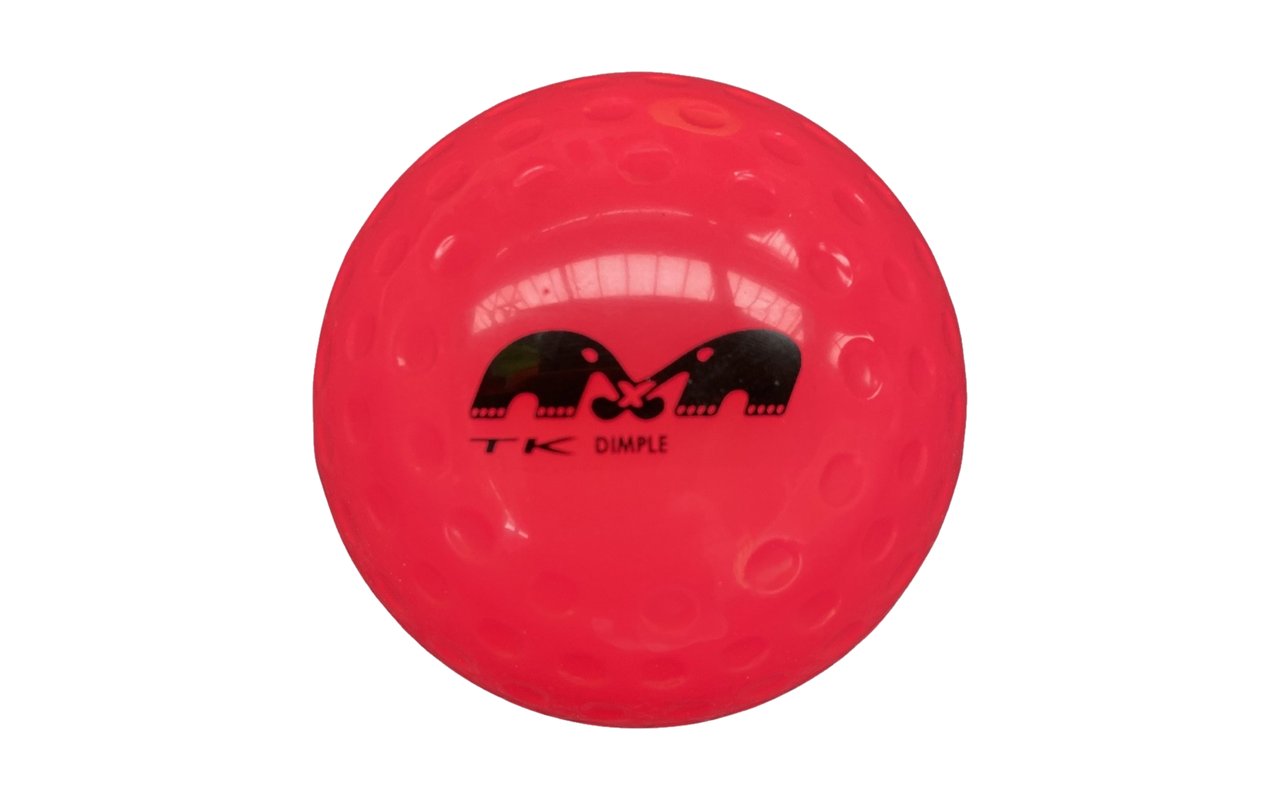
Several balls are useful for receiving drills, so as not to waste time running after one. The product page of the TK Dimple Ball describes it as a basic ball for training and matches, with a textured dimple surface, in three colours: white, yellow and pink. Other models and their purpose according to the product pages you will find in the category field hockey balls.
What in the equipment helps you receive
Receiving is above all technique, but two things in the equipment affect it. The first is stick length: a stick that is too long makes it harder to get the head low, and one that is too short forces you to bend too much. How to choose the length is described in our size guide. The second is the grip: a slippery grip makes the stick turn in the hand on contact with a hard pass, especially on a wet pitch. A grip that holds your hand you will find in the category hockey stick grips.
The bow profile matters too. The post on the plays describes how a stick with the maximum bow point closer to the head usually makes it easier to get under the ball, at the cost of a harder reception; the product pages of stiff sticks with a high carbon share also note that they need a cleaner reception. If you are only learning to receive, a more forgiving stick will make your work easier. Sticks of all brands in our range, with the profile and level according to the product pages, you will find in the category field hockey sticks.