

Blog
The penalty corner (short corner) – how it works and what protective kit defenders wear

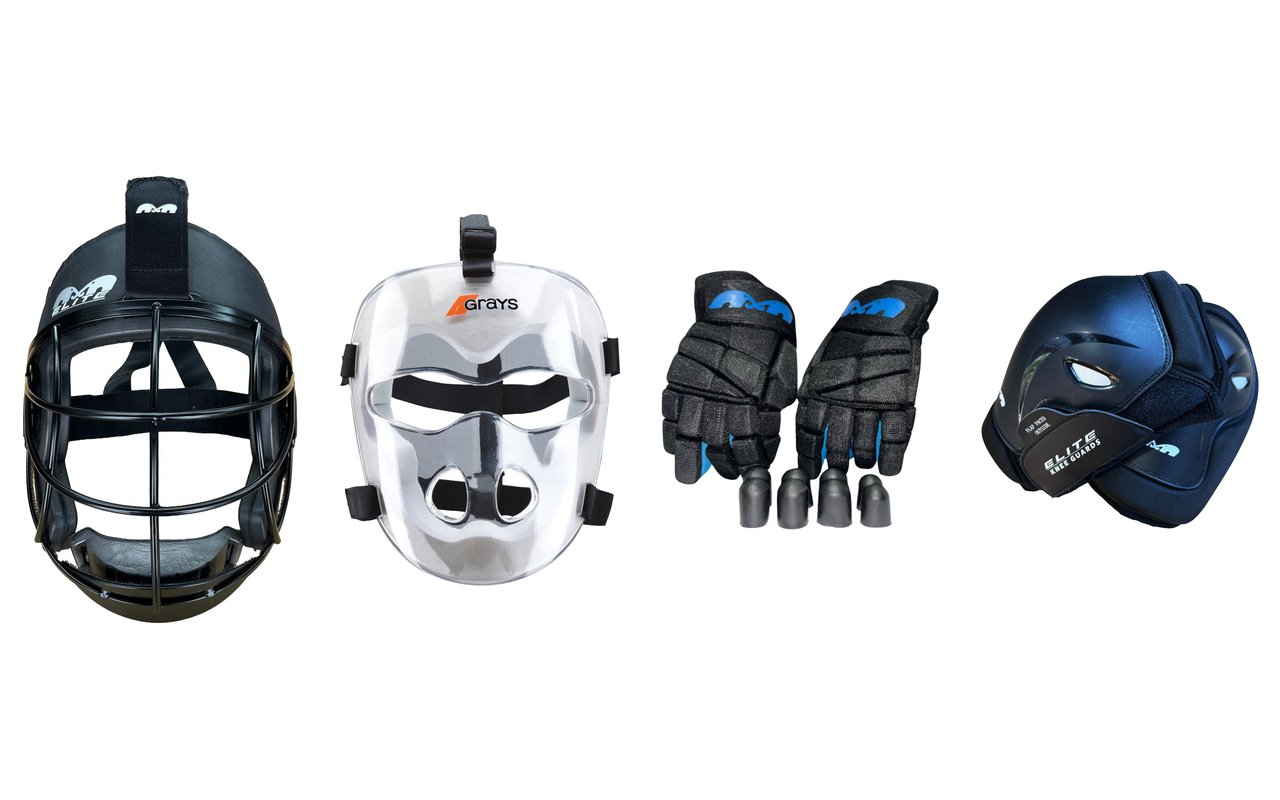
The penalty corner, also known as the short corner, is a set piece from which teams regularly score goals. For defenders it is also a moment of heightened risk: the ball travels from well over ten metres away straight at a group of players running out of the goal. We describe when the umpire awards a penalty corner, what the set-up looks like and what the FIH rules (Rules of Hockey 2026) say about defenders' protective equipment.
When the umpire awards a penalty corner
Rule 12.3 lists five situations:
- an offence by a defender in the circle which does not prevent the probable scoring of a goal,
- an intentional offence in the circle by a defender against an opponent who does not have possession of the ball or an opportunity to play it,
- an intentional offence by a defender outside the circle but within the 23-metres area they are defending,
- a defender intentionally playing the ball over their own back-line, except when it is deflected by the goalkeeper,
- the ball becoming lodged in a player's clothing or equipment while in the circle they are defending.
The most common example of the first situation is the ball making contact with a defender’s foot in the circle, if that contact constitutes an offence. If an offence in the circle prevented the probable scoring of a goal, the umpire awards a penalty stroke, not a penalty corner (rule 12.4).
The set-up under rule 13.3
- The ball is placed on the back-line inside the circle, at least 10 metres from the goal-post, on whichever side the attacking team prefers.
- The injector has at least one foot outside the pitch. They push or hit the ball without intentionally raising it.
- The other attackers are on the pitch outside the circle; their sticks, hands and feet do not touch the ground inside the circle.
- No more than five defenders, including the goalkeeper, line up behind the back-line. The remaining defenders wait beyond the centre-line.
- Apart from the injector, nobody may be within 5 metres of the ball.
- Until the ball has been played, attackers do not enter the circle and defenders do not cross the back-line or the centre-line.
- A goal cannot be scored until the ball has travelled outside the circle.
For breaking too early a defender is sent beyond the centre-line, and the team defends the re-taken penalty corner with fewer players (rule 13.6). That is why starting exactly as the ball is played is practised as carefully as the run itself.
The first shot and the 460 mm limit
If the first shot at goal is a hit, the ball must cross the goal-line, or be on a path which would result in it crossing the goal-line, at a height of not more than 460 mm, the height of the backboard, before any deflection. Flicks and scoops may be higher, provided they are not dangerous. Rule 13.3 also settles what happens when a defender is struck: if they are within 5 metres of the first shot and the ball hits them below the knee, the umpire awards another penalty corner; being struck on or above the knee in a normal stance means the shot is judged dangerous and a free hit goes to the defence. A defender who is clearly running into the shot or into the taker without attempting to play the ball with their stick is penalised for dangerous play. We write about the shooting technique itself in our post drag flick.
What rule 4.2 says about defenders' equipment
| Item of equipment | Status in rule 4.2 | Conditions in the rule |
|---|---|---|
| Face mask | recommended when defending a penalty corner or penalty stroke | smooth, preferably transparent or single-coloured, or a metal grill mask; following the contours of the face |
| Hand protection | permitted | must not increase the natural size of the hands significantly; must fit into an open-ended box measuring 290 × 180 × 110 mm |
| Knee and leg protection | permitted when defending a penalty corner | under the playing kit; knee pads may be worn outside the socks if they are exactly the colour of the socks or black |
| Other body protection | permitted | worn underneath normal playing clothing |
| Shin guards and mouthguard | recommended throughout the match | no further conditions in this rule |
Two things are worth remembering. First, the FIH 2026 rulebook itself recommends a face mask; the regulations for a particular competition may make it mandatory, and at all FIH events every player defending a penalty corner must wear one. England Hockey strongly recommends face masks across all age groups. Second, apart from the medical exception, rule 4.2 permits protective headgear when defending a penalty corner or penalty stroke. After the penalty corner is completed, however, rule 13.3(n) allows equipment to remain on temporarily within the defending 23-metres area if there was no safe opportunity to remove it. A player must not use the mask in a manner which is dangerous to others.
Putting masks on and taking them off
Once a penalty corner is awarded, time and play are stopped, and the teams should take up their positions as quickly as possible. Masks and gloves must not be kept in the goal: rule 1.10 prohibits placing any equipment there, so the set waits behind the back-line next to the goal.
- Equipment is removed safely and as soon as possible after the penalty corner is completed.
- If there is no suitable opportunity, a player may keep playing in the mask within their own 23-metres area. Before leaving it, or when instructed by the umpire, they must take the equipment off.
- When the ball is played over the back-line or side-line by an attacker, or a free hit is awarded to the defending team within its 23-metres area, a defender still wearing equipment may pass the ball immediately but must not take a self-pass.
- If the ball hits discarded equipment, the umpire awards a free hit outside the circle. Inside the circle a penalty corner is awarded, or a penalty stroke if the incident prevents the probable scoring of a goal.
- If thrown equipment strikes an opponent, an umpire or another person outside the field on or above the knee in a normal stance, the player receives a yellow card. Deliberately throwing equipment at a person may result in a more severe penalty.
A penalty corner is completed when, among other things, a goal is scored, the defence is awarded a free hit, the ball travels more than 5 metres from the circle or goes over the back-line without another penalty corner being awarded (rule 13.5).
What the 2027 edition changes
In September 2026 the FIH published the Rules of Hockey 2027. At international level they apply from 1 November 2026, while national associations decide on the date for domestic competitions. In rule 4.2 the face mask at a penalty corner, along with shin, ankle and mouth protection, moves from “recommended” to “strongly recommended”. Rule 13.3 gives a guideline of 40 seconds between the award and the start of a penalty corner. Rule 13.3(n) clarifies that, after the penalty corner is completed, merely leaving the 23-metres area is not the basis for a penalty; the offence is taking part in play while wearing equipment when the rule requires it to have been removed. The penalty is a free hit outside the circle or a penalty corner inside the circle, unless a more severe penalty is appropriate.
How to choose a mask, gloves and knee guards
- Face mask – it should sit close to the face and not shift when you run or turn your head sharply. Try it on with your mouthguard in and check that you can see the ball at your feet. Transparent models and metal grill models are equal under rule 4.2; the choice comes down to fit and field of vision.
- Penalty corner gloves – are thicker than an ordinary field glove and are sometimes sold as a pair. They must meet the same size limit, and after the corner they have to come off together with the mask.
- Knee guards – especially useful for runners. Check the colour: outside the socks only the colour of the socks or black is allowed.
- Your own set – England Hockey recommends that players own their own face mask, with club masks provided only as a last resort. Your own mask fits you and is always to hand.
Some defenders, especially runners, also use additional foot guards. Before the match, ask the umpire or check the competition regulations to see whether a particular model is allowed.
We described the players' roles at a penalty corner in our post positions on the pitch, and the indoor version of this set piece in our post indoor hockey – the rules. You will find masks and knee guards in our category Protection, and gloves, including penalty corner sets, in our category Gloves.