

Blog
Hockey glossary – 30 terms you will hear at training and in the stands

The first weeks at the pitch sound like a foreign language. We have gathered thirty terms you hear at training and at matches, each with a short explanation. Rule definitions follow the current FIH Rules of Hockey, the world governing body’s rules, which competitions in Poland are also based on.
Pitch and match
- Circle (the D) – the area in front of the goal marked by a D-shaped arc. For a goal, an attacker must play the ball inside the circle before it crosses the goal-line; it must not leave the circle in between.
- 23-metre line – a line across the pitch 23 metres from each back-line. The zone between it and the goal is the 23-metre area, where some separate rules apply.
- Quarters – under the FIH rules a match consists of four quarters of 15 minutes, with short breaks and a longer half-time interval. In youth competitions, playing time is set by the regulations of the given competition.
- Restart from the 23-metre line – when a defender unintentionally plays the ball over their own back-line, the attack restarts from the 23-metre line, in line with where the ball went out. Older supporters still call it a “long corner”, but that name is no longer in the rules.
- Free hit – the restart after an offence. The ball must be stationary and opponents must be at least 5 metres away.
- Self-pass – the player taking a free hit does not have to pass to a team-mate and may simply move off with the ball. That is why play restarts so quickly after the whistle.
- Short corner (penalty corner) – a set piece awarded, among other things, for a defender’s offence inside the circle. The ball is played out from the back-line, the attackers wait outside the circle and the masked defenders stand behind the goal-line. We described the whole sequence in the post on the penalty corner and defenders’ protective kit.
- Penalty stroke – a one-on-one between a player and the goalkeeper from a spot 6.40 metres from the goal. Awarded for an offence in the circle that prevents the probable scoring of a goal.
- Shoot-out – a way of deciding a drawn match at tournaments: a player starts with the ball from the 23-metre line and has limited time to beat the goalkeeper. The FIH rules refer to tournament regulations here.
Technique
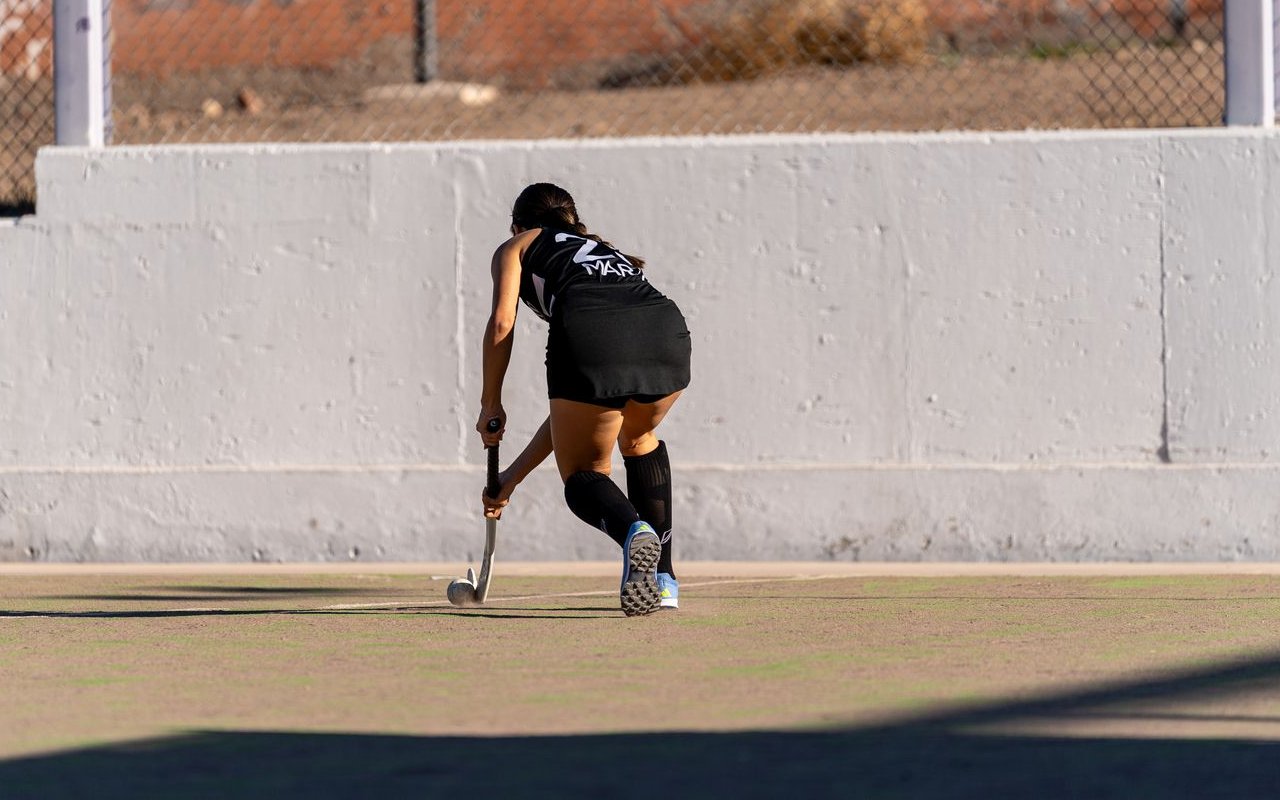
- Push – moving the ball along the ground without a swing, with the head of the stick in contact with the ground throughout. The first technique beginners learn and the basis of an accurate pass.
- Flick – a push that lifts the ball off the ground. Used for aerial passes and at the penalty stroke.
- Hit – a stroke with a swing, the most powerful in the repertoire. The variant with a long, sweeping movement of the stick is the “slap”, which the rules treat the same as a hit.
- Drag flick – a short-corner shot in which the player drags the ball along the ground and releases it at high speed. A technique for advanced players.
- Backhand (reverse) – play with the stick turned over, usually with the ball to the left of the body; the flat face can be used to receive or pass. A tomahawk is a reverse hit using a permitted edge. Playing with the rounded back of the stick is not allowed.
- Tackle – an attempt to take the ball off an opponent. A quick, short poke at the ball from distance is the “jab”.
- 3D skills (lifting the ball) – getting past a defender’s flat stick by lifting the ball slightly over it. Permitted as long as it is not dangerous.
Kit
- Stick head – the curved lower part used to play the ball. It has one flat side and one rounded side; only the flat side and the edges may be used. A hard forehand hit with the edge of the stick is prohibited.
- Bow – the curve of the shaft, visible when the stick is laid on the ground. A lower bow makes lifting the ball easier, a higher one gives calmer ball carrying. We explain the differences in the post on low, mid and standard stick bows.
- Grip – the tape on the stick handle, made of chamois or synthetic material. It provides grip; replace it when it slips, wears through or peels away, following the manufacturer’s instructions.
- Shinguards – shin protection worn under the socks. The FIH rules recommend them for field players; whether they are compulsory is set by the competition regulations and club rules.
- Mouthguard – a guard for the upper teeth, fitted according to the instructions for that model. Like shin guards: recommended in the FIH rules, while the requirement for children is decided by the competition regulations and the club.
- Field hockey glove – protection for the hand against contact with the ball, a stick or the ground. A left-hand model protects the hand during a low block, among other situations; the choice of hand and coverage depends on the play and the glove’s design.
- Penalty corner mask – a clear or grille face mask that defenders put on only to defend a short corner or a penalty stroke. After the corner, remove the mask when it is safe to do so. Until then, play may continue within the 23-metre area; a self-pass is not allowed.
Rules and cards
A match is controlled by two umpires, each responsible for their half of the pitch.
- Feet – the ball touching the foot or body of a field player. Not every touch is an offence: the umpire blows when the player gained an advantage or deliberately stopped the ball with the body.
- Obstruction – shielding the ball with the body or stick from an opponent who is within playing distance and trying to play it. Also backing into an opponent or blocking them off the ball.
- Dangerous play – a play that forces an opponent to take evasive action, most often a ball raised high towards players. The penalty is awarded where the danger arose.
- Cards – green means a warning and a 2-minute suspension, yellow at least 5 minutes, red exclusion for the rest of the match. For the whole suspension the team plays a player short.
Competitions in Poland
- Superliga and I liga – the two levels of senior competition in Poland, played in both the outdoor and the indoor season.
- Youth categories – competitions divided by year of birth, from the youngest groups up to juniors. Age limits are set by the regulations of the given competition.
- PZHT – the Polish Field Hockey Association, organiser of the competitions and in charge of the national teams. We write about clubs, leagues and the association’s history in the post on hockey in Poland.
Where to start
From this list, three things are enough in the first weeks: push, circle and feet. The rest comes with further training sessions and matches. Apart from the stick, a beginner needs shin guards and a mouthguard above all. You will find the available sizes and models in the category protection.