

Blog
Tackling in field hockey – forehand and reverse tackles, the defender’s stance, the rules and drills


This is a follow-up to the post Carrying the ball in field hockey – open and closed carrying, on the run and under pressure: technique and drills. That post describes the player with the ball; this one describes the player who wants to take it away. Tackling in field hockey is an attempt to take the ball off an opponent with the stick, without contact with their body. Below you will find the rules that apply to tackling, the defender’s stance, the forehand tackle, the reverse tackle and the jab, choosing the moment, playing in pairs, mistakes and six drills.
We describe the technique for an outfield player on grass. Indoors different rules apply and tackling looks different. Practise tackling drills in shin guards and with a mouthguard, under a coach’s supervision: when tackling, the stick and ball work close to both players’ legs.
Tackling in field hockey: what the FIH rules say
Before you start practising the technique, learn the limits. The FIH rules of hockey describe them directly, and we discuss them in more detail in the post What the umpire blows for: feet, high sticks, obstruction. The key sentences for a defender:
Players must not touch, handle or interfere with other players or their sticks or clothing, so hitting an opponent's stick instead of the ball is an offence. A tackle is allowed only when the player can play the ball without body contact. Sliding tackles and other overly physical challenges that take an opponent to ground and have the potential to cause injury should, under the rules, attract match and personal penalties. On top of that there are two rules about the stick itself: players must not play the ball with the back of the stick or hit the ball hard on the forehand with the edge of the stick.
The rules also protect the defender. Under the FIH rules, players obstruct if they back into an opponent, physically interfere with the stick or body of an opponent, or shield the ball from a legitimate tackle with their stick or any part of their body. So if the player with the ball shields it with their body while you are attempting a legitimate tackle, they commit the offence, not you.
These sentences give three practical rules on the pitch:
- Play the ball, not the stick. The aim of a tackle is the ball. Hitting an opponent’s stick instead of the ball is an offence.
- No body contact. If you cannot reach the ball without going into the player, a tackle is not possible at that moment. You need to move and wait for a better chance.
- No sliding tackles. Throwing yourself to the ground for the ball in a way that takes an opponent down is treated by the rules as an overly physical challenge.
The defender’s stance before a tackle
A tackle starts a few steps earlier, in the positioning. A defender standing upright with the stick in the air reacts too late; a defender set low with the stick on the ground has time to decide. Elements of the stance:
- Legs. Roughly shoulder-width apart or slightly wider, knees bent, weight on the balls of the feet. From this position you can move either way without repositioning your whole body.
- Upper body. Leaning forward, back fairly straight, head over the ball or in front of it. A low position shortens the stick’s path to the ball.
- Stick. Head on the ground or just above it, in front of the body. A stick held high first has to be lowered, and that costs time you do not have in a tackle.
- Grip. Left hand at the top of the handle, right hand lower. In a two-handed tackle both hands work together; for the jab only one remains, the left.
- Eyes. Watch the ball and the opponent’s stick, not their dummies with the upper body. The ball only changes direction when the stick touches it.
The distance from the player with the ball is chosen so that they cannot get past you with one move, and at the same time so that the ball is within reach of your stick when the opponent makes a mistake. Too close means a risk of contact and an easy dummy past you; too far means the opponent has time to pass or accelerate. It is best to establish this distance with your coach in one-on-one drills.
Channelling the opponent: before you start tackling
A good defender does not dive in for the ball at the first opportunity. First they position themselves so that the player with the ball can only go one way, and the way the defender wants. This work is called channelling the opponent (in Polish, kierowanie przeciwnika).
- Towards the sideline. The sideline works like an extra defender: a player channelled along it has less space and fewer passing options.
- Onto their reverse side. A player with the ball carried on the left side of the body has to play on the reverse or turn with the ball. Playing on the reverse or turning with the ball takes time, and the defender can use it.
- Away from the centre and the circle. The further the ball is from the goal and from the centre of the pitch, the less dangerous the attack, even if the tackle fails.
Channelling is footwork. The defender moves sideways with a shuffle step, keeping a low stance and the stick on the ground. Crossing the legs when running sideways makes a quick change of direction harder, so in training it is worth sticking to the shuffle step. Once the player with the ball is being channelled where you want, you wait for the moment to tackle.
Tackling techniques: forehand block, reverse and jab
In field hockey a defender has three basic tackling techniques. Each suits a different situation: the forehand block for an opponent on the defender’s right or facing them, the reverse for an opponent passing the defender on the left, and the jab for a player who is still some distance away.
Forehand tackle: the block on the flat side of the stick
The forehand tackle, also called the block, is the basic tackling technique. The defender puts the flat side of the stick in the ball’s path and stops it instead of hitting it. Steps:
- Position yourself so that the opponent is on your right or facing you, in a low stance.
- Lower the stick to the ground with the flat side to the ball, both hands on the handle. The stick can lie more horizontally, covering more of the ball’s path, or stand more upright for a quicker challenge; decide this with your coach depending on the situation.
- Step into the ball’s path at the moment the ball moves away from the opponent’s stick, not when it is glued to their stick head.
- Stop the ball and take control straight away: pass, carry or clear it away from the opponent.
What matters most is what the defender does not do: they do not swing the stick at the ball and do not hit the opponent’s stick. In the block the stick stays still or moves together with the defender; the ball runs into the stick. That is why the block is a patient technique. Anyone who tries it too early gives the player with the ball time to dummy past the stick.
Forehand block on the run
In a match the block is also made on the move, when the defender runs alongside the player with the ball. The stick is then carried on the ground in front of the body, and the defender waits until the ball moves away from the opponent’s stick when they touch it. At that moment the stick comes in between the ball and the opponent’s stick. Run parallel to the opponent and do not cut into their running line, because that leads to body contact.
Reverse tackle
When the player with the ball passes the defender on their left, the forehand does not reach. That leaves the reverse tackle: the stick turned so that the flat side faces left, head on the ground. It is a harder technique than the forehand block and riskier, because contact happens easily.
- Stick on the ground, in front of the body. A reverse with the stick raised and swung at the ball easily ends with hitting the opponent’s stick or legs.
- Move to the ball, not through the player. The stick comes into the ball’s path from the front and does not cut across the opponent’s legs from behind.
- Body alongside, not in front. The defender does not step with their upper body in front of the player with the ball to reach with the reverse; that is body contact.
- If you cannot reach, let it go. It is better to turn and keep channelling the opponent than to risk an offence which, in the defensive zone, may end in a penalty corner.
The reverse tackle needs a lot of repetition at a slow pace. At first practise it without an opponent, on a ball rolled by a partner, then with a partner carrying the ball at walking pace, and only at the end on the run.
Jab: a quick poke at the ball from distance
In our glossary we describe the jab as a quick, short poke at the ball from distance. The defender holds the stick in one hand, the left, extends it forward and with a short movement knocks the ball away from the opponent’s stick. A jab does not have to win the ball outright: sometimes it is enough to knock it out of the player’s reach or force them to stop.
- When a jab makes sense. When the opponent is carrying the ball far from the stick or when you need to slow them down before help arrives. A jab from distance gives the defender time, because it does not require getting in close.
- The risk. A one-handed jab has less power and less control than a two-handed block. After a failed jab the defender is stretched forward, so they have to get back into a low stance quickly.
- Watch the stick. A jab hits the ball, not the opponent’s stick. With a quick one-handed movement it is easy to hit the stick, and that is an offence.
When to go in for the tackle
Tackling technique is easy to demonstrate; choosing the moment is harder. A defender who goes in at the wrong moment gets beaten, even if their stick is positioned correctly. Moments that give the defender an advantage:
- The opponent receiving the ball. As the ball is just reaching them, their attention is on receiving. If the reception bounces off, the ball is loose.
- The ball far from the stick. When carrying fast with an open stick, the ball runs ahead of the player. That is the moment for a block or a jab.
- The opponent looking down. A player who is looking at the ball does not see the defender or teammates; it is easier to surprise them.
- The opponent near the sideline. When channelling has worked, the player has little space and fewer options.
- A teammate’s support. When a second defender closes the path, the risk of tackling is lower, because even after a failed attempt someone is still behind you.
A moment when going in is risky: the opponent is carrying the ball close to the stick, with their head up and at full speed. Then it is better to keep channelling and wait than to go in and get beaten.
Tackling in different areas of the pitch
The same tackling technique carries different weight depending on where you are on the pitch. A risk that is reasonable near the halfway line can cost a goal near your own circle.
- The opponent’s half. A tackle far from your own goal can give the team an attack straight away. A failed attempt costs less here, because the whole team is still behind the defender. This is the area where you may go in for the tackle more boldly, in line with the coach’s game plan.
- Midfield. Here channelling the opponent to the sideline pays off most. It is worth coordinating the tackle with a teammate who is covering.
- The 23-metre area in front of your own goal and the circle. Here every offence has bigger consequences. Under the FIH rules a penalty corner is awarded, among other things, for an offence by a defender in the circle which does not prevent the probable scoring of a goal and for an intentional offence by a defender in their 23-metre area outside the circle. That is why in this area the defender chooses the safe block over the risky reverse and goes in for the tackle when a teammate is covering.
On top of that come personal penalties. Cards are personal penalties and may be added to a match penalty. A green card means a warning and a temporary suspension for 2 minutes of playing time, a yellow card a suspension for a minimum of 5 minutes of playing time, and a red card a permanent suspension for the rest of the match. For the duration of each suspension the team plays with one fewer player. A defender who keeps making illegal tackles therefore puts not only themselves but the whole team at a disadvantage.
Tackling in pairs and as a team
In a match the defender does not have to be left alone with the player with the ball. The team defends together, and the tackle is the last step in the work of several players.
- The first defender channels the player with the ball, slows them down and closes off one side. They do not have to tackle straight away; their job is not to get beaten.
- The second defender positions themselves behind the first and slightly to the side, on the side the opponent is being channelled towards. When the player with the ball gets past the first, they meet the second.
- Doubling up. When two defenders close down the player with the ball near the sideline, one of them can go in for the tackle with less risk. Care is needed so that the two of them do not run into the opponent.
- Communication. Short calls, agreed with the coach, tell a teammate who goes in for the tackle and who covers.
A defender who has won the ball has one task: pass it on straight away or carry it out of the danger area. A ball that is won and then lost at once gives the opponent a second chance to attack.
Tackling mistakes and how to correct them
Below are the mistakes that spoil a tackle. Each one has a simple correction that can be practised.
| Mistake | What happens | How to correct it |
|---|---|---|
| High stance, stick in the air | The defender reacts too late, the ball runs under the stick | Knees bent, stick head on the ground in front of the body |
| Going in for the tackle too early | The opponent has the ball on the stick and beats the defender with a dummy | Channel and wait until the ball moves away from the stick |
| Swinging the stick at the ball | Hitting the opponent’s stick, an offence | Block: the stick stands in the ball’s path, the ball runs into the stick |
| Stepping in front of the opponent with the upper body | Body contact, an offence | Run parallel, reach with the stick, not the body |
| Crossing the legs when moving sideways | The defender does not change direction in time | Shuffle step in a low stance |
| Reverse with a swing | The stick hits the opponent’s stick or legs | Reverse with the stick on the ground, moving to the ball from the front |
| No decision after winning the ball | The ball that was won goes back to the opponent | Pass straight away or carry it out of the danger area |
| Tackling without cover in the defensive zone | After being beaten nobody closes the path to the goal | In the defensive zone go in for the tackle when a teammate is covering |
Six tackling drills
The drills are arranged from the simplest to the hardest. Do all of them in shin guards and with a mouthguard, under a coach’s supervision. Start at a slow pace and add speed only when the defender is not hitting the partner’s stick.
1. Block on a rolled ball
A partner rolls the ball by hand or with a gentle push towards the defender, once to the right, once in front. The defender in a low stance stops the ball with a forehand block and returns it to the partner. Sets of 10 repetitions, then swap roles. Aim: the habit of keeping the stick on the ground and a still block.
2. Footwork in a channel
Cones mark a channel a few metres wide. The player with the ball walks from one end to the other, changing direction. The defender moves in front of them backwards and sideways, with a shuffle step and the stick on the ground, without attempting to tackle. Aim: stance and channelling without rushing.
3. Channelling to the line
As in drill 2, but the defender has to channel the player with the ball to one line of the channel, chosen by the coach. A tackle is allowed only when the player with the ball reaches that line. Aim: patience and choosing the moment.
4. Reverse at walking pace
The player with the ball walks past the defender on their left. The defender attempts a reverse tackle with the stick on the ground. The coach stops the drill at every hit on the stick or body contact and discusses the positioning. The pace goes up only after a series of clean tackles.
5. Jab and recover
The player with the ball carries it with an open stick, with the ball clearly in front. The defender makes a jab and immediately gets back into a low stance and keeps channelling the opponent. Aim: the jab as the start of defending, not a one-off lunge.
6. Two against one in defence
One player with the ball, two defenders. The first channels, the second covers and takes over when the player with the ball gets past the first. After the tackle the defender passes the ball to the coach or over a marked line. Aim: the roles of the first and second defender and communication.
A plan for learning to tackle in four stages
- Stance and stick on the ground. Drills 1 and 2, without an opponent carrying the ball for real. The stage ends when the defender keeps a low stance throughout the set.
- Channelling and patience. Drill 3. The defender learns that they do not have to tackle straight away.
- Reverse and jab. Drills 4 and 5 at a slow pace, stopping at every hit on the stick.
- Tackling in play. Drill 6, then small-sided games in which the coach assesses not only the balls won but also the offences.
At every stage the measure of progress is the number of clean tackles without an offence, not just the number of balls won. A tackle made with contact or by hitting the stick ends with a whistle in a match, so it should not count in training either.
Kit and tackling
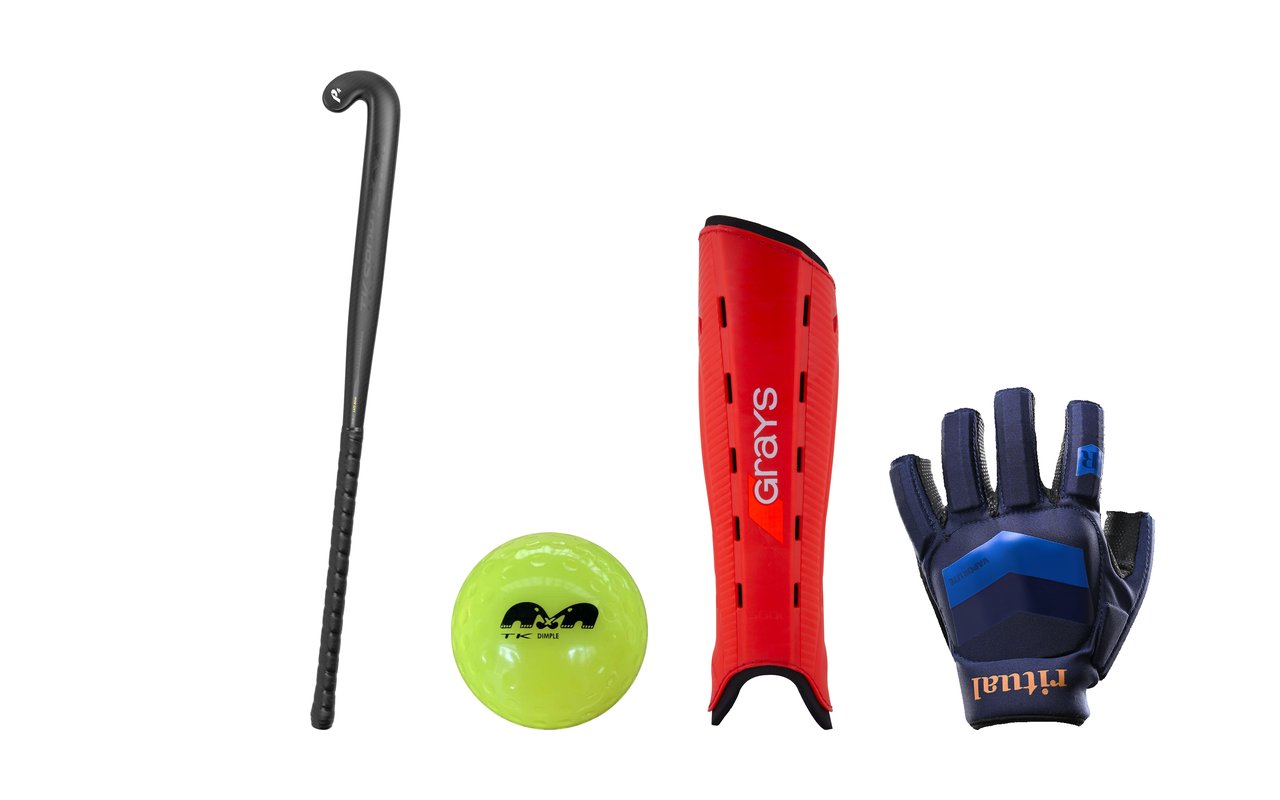
When tackling, the stick, the ball and both players’ legs are close together, so protection matters a lot here. Shin guards protect the shins from being hit by the ball and the stick; we explain how to choose them and what else is worth wearing in the post Shin guards and mouthguards – what is compulsory and what is sensible. A glove on the left hand protects the back of the hand and the fingers, which are closest to the opponent’s stick in a reverse tackle and a jab.
The stick itself also matters. For the block and the jab a player needs a stick of the right length: one that is too long makes a low stance harder, one that is too short forces them to bend too far. It is worth checking the length against the table in the size guide, and comparing models in the field hockey sticks.
You will find shin guards, masks and other protection for outfield players in the field hockey protection.