

Blog
Indoor hockey – the key rule differences from outdoor hockey

In a few weeks Polish clubs move from the turf into sports halls. The stick and ball look much the same, but the rules of the game differ in several places so sharply that outdoor habits end with the umpire's whistle. We have collected the key differences according to the FIH rules, with rule numbers, so that you can check them at source.
Which rules apply
Indoor hockey has its own document: the FIH Rules of Indoor Hockey. In September 2026 the FIH published a new edition labelled 2027. At international level it applies from 1 November 2026, while national associations decide when to introduce it in domestic competitions. Before the season, check your competition regulations to see which edition you are playing under. The rule numbers given below are the same in the 2023 and 2027 editions unless we say otherwise. For outdoor hockey we refer to the Rules of Hockey 2026.
Pitch, team sizes and playing time
| What we compare | Indoors | Outdoors |
|---|---|---|
| Pitch dimensions (rule 1.1) | recommended 44 × 22 m, minimum 36 × 18 m | 91.40 × 55 m |
| Longer sides of the pitch (rule 1.2) | side-boards | side-lines |
| Players of one team on the pitch (rule 2.1) | no more than 6 | no more than 11 |
| Playing time (rule 5.1) | 4 quarters of 10 minutes | 4 quarters of 15 minutes |
| Distance of opponents at a free push or free hit (rule 13.2) | at least 3 m | at least 5 m |
| Penalty spot | 7 m from the goal-line (rule 1.6 in the 2027 edition, previously 1.5) | 6.40 m from the goal-line (rule 1.7) |
The regulations of a particular competition may set different playing times and intervals, which rule 5.1 expressly allows.
The ball must not be hit
Rule 9.5 of the indoor rules is short: players must not hit the ball. The terminology section defines a hit as striking the ball with a swinging movement of the stick and includes the “slap”, a long sweeping movement of the stick before contact with the ball. The ball is moved with a push: the head of the stick is placed close to the ball, and both stick and ball stay in contact with the floor. Outdoors the hit is an everyday stroke, so this is the first habit to switch off indoors.
The ball stays on the floor
Under rule 9.9 the ball must not be raised off the floor, with one exception: a shot at goal. The rule adds that it is not an offence if the ball rises unintentionally by less than 100 mm, unless an opponent is within playing distance. Outdoors an aerial pass (flick or scoop) is permitted provided it is not dangerous.
Rule 9.10 forbids playing the ball while it is in the air. Under the 2023 edition, it may generally be stopped by a player from the team that did not put it in the air; after a legitimate shot at goal rebounds from the goalkeeper, a defender, a goal-post or the cross-bar, a player from either team may stop it. The 2027 edition removes that distinction: the ball may be stopped and may also be brought under control by pressing it down with the flat side of the stick. A goal can only be scored if the ball was on the floor at the attacker’s last contact.
Knee and hand on the floor
The outdoor rules contain no such rule. Rule 9.12 says that a field player must not play the ball while lying on the pitch or with a knee, arm or hand on it, other than the hand holding the stick. A low body position is routine indoors, but a block made from a kneeling position is an offence. A goalkeeper may play the ball while lying down inside their own circle (rule 10.5).
Side-boards: an aid to play, not a trap
- A ball that rebounds off the side-board remains in play. It is out of play only when it passes completely over the side-board or the back-line (rule 7.1).
- When the ball goes over the side-board, play is re-started within 1 metre of where it crossed the board (rule 7.3). If the restart would be inside the circle, place the ball one metre outside it and one metre from the side-board.
- The ball must not be trapped or held against the side-boards, and a player in possession must not be shut into the corner or against the boards by opponents with their sticks flat on the floor; opponents must leave a reasonable outlet for the ball. This is rule 9.14 in the 2027 edition; in the 2023 edition it was numbered 9.19.
- If the ball becomes unintentionally trapped between sticks or against the side-boards, play is re-started with a bully.
Ball over the back-line
Rule 7.4 works differently indoors and outdoors. If an attacker played the ball over the back-line, the defence re-starts play up to 9.10 m from that line. If a defender did so unintentionally, or the goalkeeper deflected the ball, play is re-started on the centre-line, in line with where the ball left the pitch; outdoors this is the 23-metres line. A defender intentionally playing the ball over their own back-line means a penalty corner in both versions of the game.
Free push and penalty corner
An indoor free push is taken with a push, and opponents stand at least 3 metres from the ball (rule 13.2).
At a penalty corner (rule 13.3) the ball is placed on the back-line at least 6 metres from the goal-post; outdoors it is 10 metres. If the defending team has a goalkeeper, the goalkeeper stands in the goal and up to five other defenders line up behind the back-line on the side of the goal furthest from the injector. If the team plays with field players only, up to six defenders may line up behind the back-line outside the goal. The ball is injected with a push, and a goal cannot be scored until the ball has travelled outside the circle. As there is no hitting indoors, there is also no equivalent of the outdoor 460 mm limit for a first hit at goal. The shot may be raised to any height as long as it is not dangerous.
Where the goalkeeper may play
Outdoors a goalkeeper must not take part in play outside the 23-metres area they are defending, while indoors the limit is the centre-line (rule 10.1). In both versions, taking a penalty stroke is the exception. A team may play with a fully equipped goalkeeper or with field players only (rule 2.2).
What this means for equipment
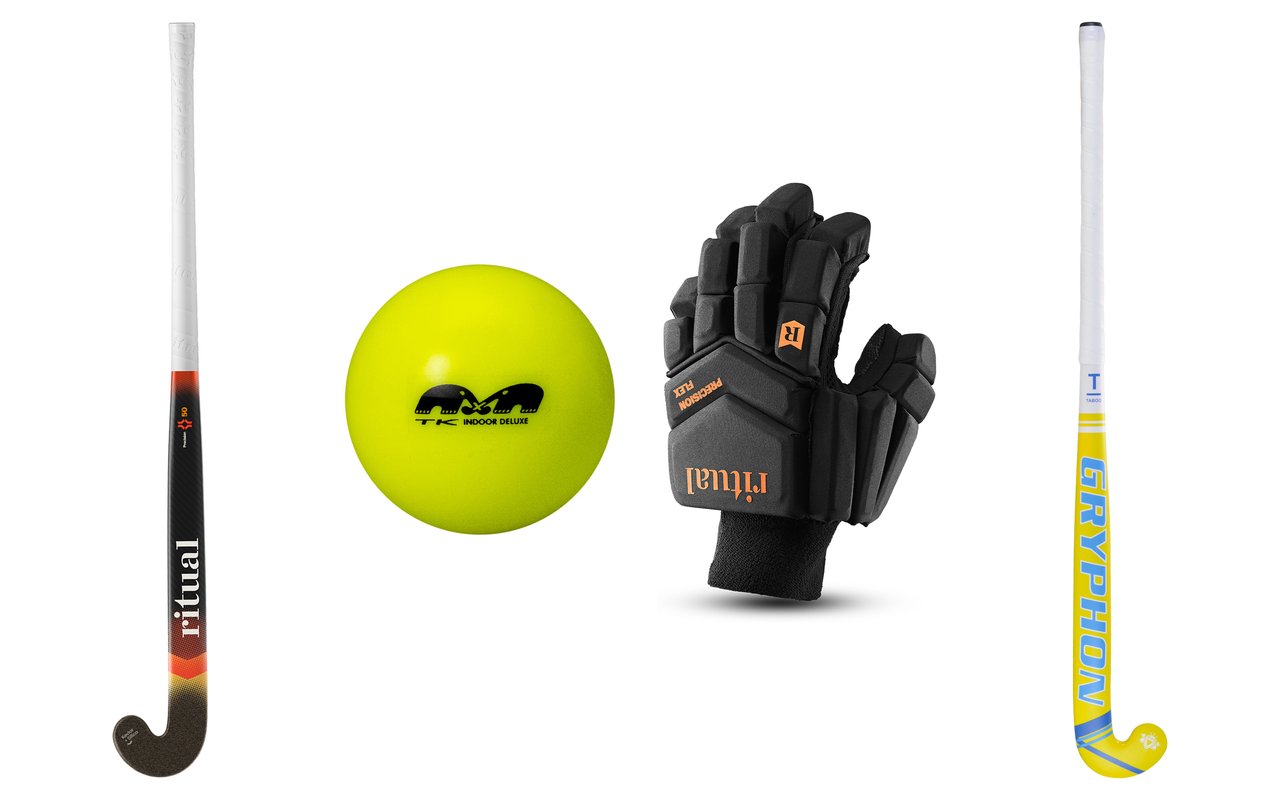
The indoor rules set no separate limits for the stick and ball. The stick must pass through a ring with an interior diameter of 51 mm and may have a bow of up to 25 mm (rule 4.7 in the 2027 edition, previously 4.6), and its weight must not exceed 737 g. The ball weighs 156–163 g. Indoor sticks are therefore a separate design by choice of manufacturers and players, suited to push play and a low body position, not a requirement of the rules. We explained how to tell them apart in our post indoor stick, and the differences in the game itself and in the kit in our post outdoor or indoor.
Rule 4.2 is structured similarly indoors and outdoors: hand protection is permitted if it fits into an open-ended box measuring 290 × 180 × 110 mm. Apart from the medical exception, a field player may wear a protective face mask when defending a penalty corner or a penalty stroke. The 2027 indoor rules describe shin, ankle and mouth protection, and a face mask at a penalty corner, as ‘strongly recommended’. Competition regulations may nevertheless make the mask mandatory; at all FIH events every player defending a penalty corner must wear one. We cover choosing a glove in our post field glove.
Five outdoor habits to switch off before the indoor season
- The backswing: start every stroke with the stick next to the ball.
- The aerial pass: apart from a shot at goal, the ball stays on the floor.
- The kneeling tackle: your knee and free hand stay off the floor while you play the ball.
- Holding the ball against the side-board: play it or move away from the board with it.
- Five metres at a free hit: indoors three are enough, so the opponent is on you sooner.
You will find indoor and outdoor sticks in our category Hockey Sticks, gloves in our category Gloves, and shin guards and penalty corner masks in our category Protection.